To put it bluntly, the Big Island is BIG! Most people visiting are somewhat unprepared and baffled by the sheer size of it. Of-course if your idea of a holiday is to stay for the entire duration at one of the plush Kohala resorts on one end, then size really doesn't matter does it!
However and sadly, you would be missing out on so much that this island has to offer - from pristine rain forests, to lava deserts to world-class beaches, to snow covered mountains, an active volcano, dazzling sunsets...and the list goes on and on. My point being, rent a car and get out there to experience it.
I am of the firm belief that doing out of the ordinary things, makes extraordinary happen!
 In the 5 days that we spent on the island, we crisscrossed every major road or freeway, from one end to the other, from the north to the south or east to west. And keep in mind that there are humongous volcanoes and tall tall mountains that force you to circle-around in order to get from point to point. Yes, so distances are huge and as most of the roads are single lane, the commute times are long. When did that ever stop us though?
In fact, one of the prettiest and surprising drives ended up happening by chance (when we missed a turn) and oh what a pleasant drive it was. Probably one of my favorites. Its the Akoni Pule highway (#270) north of Kawaihae and towards the sleepy town of Hawi. For one its past all the extravagant and manicured mega-resort area where ensconced in the desolate sea of lava and scrub, multi-million dollar resorts dot the coastline offering the luxury and amenities that have made this region famous.

This is probably the most overlooked and driest part of the island as it falls in the rain shadow area of the Kohala mountain. We hardly came across cars on the road or people at the pull outs! Although the coastline here is mostly rocky and unprotected with few beaches to swim in, its beauty lies in its ruggedness. The land is harsh and the winds here are unforgiving...but that is exactly what makes the drive unforgettable. A cute little hidden park with exceptional clear waters is Kapa'a Beach park. Its one place where you could take out a permit to camp overnight. If quiet and solitude is what you seek, then this is one place that answers your call.
The end of the highway leads to the scenic Polulu Valley lookout. This outstanding vista displays the raw, untamed side of the Big Island. 400 feet below is the Polulu valley beach accessed via a 20-30 minute trail on uneven terrain (good walking shoes needed here). The view's of the valley are much nicer half way down the trail.
We saw some backpackers climbing their way up after having spent the night on the beach below! Polulu connects to Waipio via 7 valleys along the Kohala mountain! However, you have to drive around the mountain to get to Waipio on the other side. Read more on Waipio Valley here. My suggestion would be to take the beautiful Kohala Mountain Road (#250) towards Waimea and then head east on the Mamalahoa Highway (#19) towards Honoka'a. Enjoy the drive!
It is one of the absolute must-dos inside the National Park. The road is very accessible, drive able with several pull-outs to step out and walk short distances to view points and magnificent vistas. It may very well be one of the most unique driving experiences you have on the Big Island, although after staying there for 5 more days, it gets increasingly difficult to pick this one as your only favorite!
Stretching approximately 18 miles and going from 4,000 ft. elevation to sea level, the Chain of Craters scenic drive along the East Rift Zone of the volcano in Hawaii Volcanoes National Park is pock marked with craters of varying shapes and sizes, lava flows, petroglyphs, and much more.
If your ultimate goal is night time lava watching, you may want to start out on Chain of Craters several hours before sunset in order to reach the end of the road with enough time to get out to the lava before dark. Add extra time (2-3 hours) if you plan on doing any of the hikes along the road or if you plan on picture taking!
One of the stops along the road is the Lua Manu Crater - the first of several marked craters along this road. Lua Manu is a pit crater which is formed when magma below the earth's surface drains, causing the earth to collapse. The 1974 flow sent lava pouring into Lua Manu's basin which is 109 yards in diameter.
Further down the road, you will see a small pullout on the left which leads to another pit crater, Puhimau Crater. Its fascinating and a surreal feeling to be viewing craters so up front, and those that erupted not more than 30-40 years ago!
Thurston Lava Tube - don't miss it. What is a Lava Tube? As magma moves underground it flows through tubes. The main magma chamber will have side tubes which are fairly large... these will splinter off into smaller and smaller tubes just like the veins in your body.
The larger tubes can be quite big. They can have ceilings that are 30 to 50 feet tall. Typically the magma that normally flows through a tube fills it about 2/3 of the way up. The heat and pressure will sometimes cause portions of the roof of the tube to collapse, exposing the interior of the tube to the outside through the collapsed roof, called a skylight.
Thurston Lava Tube is an excellent example of a large feeder tube.
Hilina Pali Road The 8.2 mile trip down narrow Hilina Pali Road has its own rustic and raw appeal in terms of gorgeous scenery. Beauty as always lies in the eye of the beholder here. The barren desolate hardened ground speak of tumultuous times when lava erupted or earthquakes rattled at its very core breaking new ground, engulfing all that came in its wake. It is a story of death, devastation but also one of resilience, regeneration and power.


Although it is so desirable and alluring to trek for miles into this barren unobstructed underworld...the strong straight line winds whip you around testing your balance. Getting a picture here calls for some serious skills...where the camera, the subject, the surroundings and God forbid YOU all have to make it into one frame! Good luck.
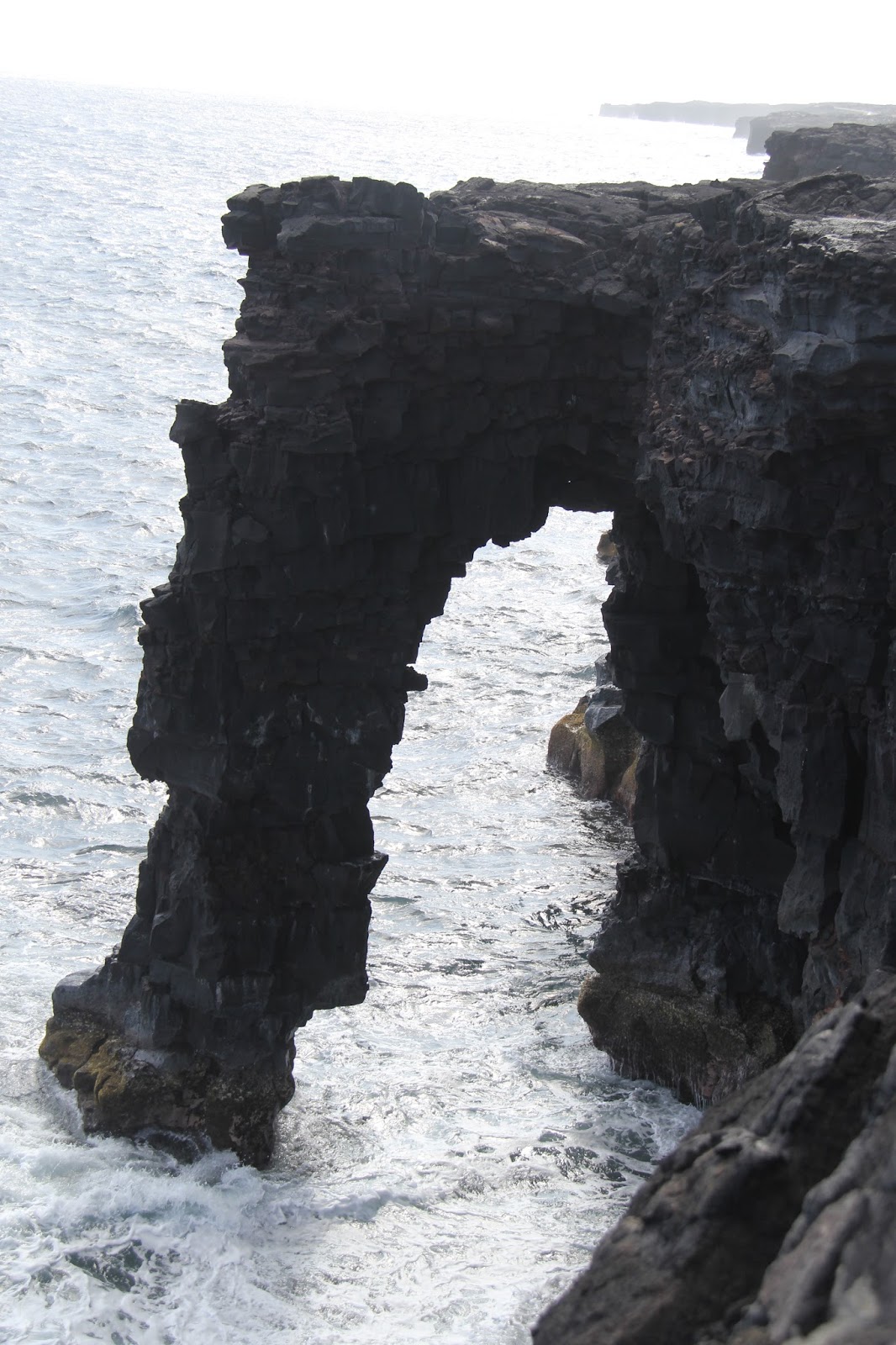
However, the awe-inspiring views at the end of this road are worth the effort if you have the time. The road continues to twist and turn over the bumpy and rutted pavement until you finally reach the Holei Sea Arch. Sea arches are formed when lava is continuously pounded by the surf until it is undercut in the shape of an arch.In a park where the main attraction is an ever-changing force of nature, there is no telling how the landscape could change. Since 1983 Kilauea has been eating portions of the Chain of Craters Road and covering the villages on it with its lava flows.
Never-the-less its lure is in its drama. In experiencing the true youth of the Big Island and the reality that it is still being born.
Currently the park allows visitors to walk 5 miles (one-way) down Chain of Craters Road to where the lava begins. This is rough terrain walking. If you plan on hiking beyond where the lava meets the road please take a few precautions. Bring plenty of water, approximately three quarts for the entire hike. Carry rain gear, sun block, and flashlights. The temperature drops with the sun, so carry a lightweight jacket or sweatshirt just in case. There is another option of viewing the active lava flowing into the ocean. See Kalapana Lava Hike
 In the 5 days that we spent on the island, we crisscrossed every major road or freeway, from one end to the other, from the north to the south or east to west. And keep in mind that there are humongous volcanoes and tall tall mountains that force you to circle-around in order to get from point to point. Yes, so distances are huge and as most of the roads are single lane, the commute times are long. When did that ever stop us though?