It is one of the absolute must-dos inside the National Park. The road is very accessible, drive able with several pull-outs to step out and walk short distances to view points and magnificent vistas. It may very well be one of the most unique driving experiences you have on the Big Island, although after staying there for 5 more days, it gets increasingly difficult to pick this one as your only favorite!
Stretching approximately 18 miles and going from 4,000 ft. elevation to sea level, the Chain of Craters scenic drive along the East Rift Zone of the volcano in Hawaii Volcanoes National Park is pock marked with craters of varying shapes and sizes, lava flows, petroglyphs, and much more.
If your ultimate goal is night time lava watching, you may want to start out on Chain of Craters several hours before sunset in order to reach the end of the road with enough time to get out to the lava before dark. Add extra time (2-3 hours) if you plan on doing any of the hikes along the road or if you plan on picture taking!
One of the stops along the road is the Lua Manu Crater - the first of several marked craters along this road. Lua Manu is a pit crater which is formed when magma below the earth's surface drains, causing the earth to collapse. The 1974 flow sent lava pouring into Lua Manu's basin which is 109 yards in diameter.
Further down the road, you will see a small pullout on the left which leads to another pit crater, Puhimau Crater. Its fascinating and a surreal feeling to be viewing craters so up front, and those that erupted not more than 30-40 years ago!
Thurston Lava Tube - don't miss it. What is a Lava Tube? As magma moves underground it flows through tubes. The main magma chamber will have side tubes which are fairly large... these will splinter off into smaller and smaller tubes just like the veins in your body.
The larger tubes can be quite big. They can have ceilings that are 30 to 50 feet tall. Typically the magma that normally flows through a tube fills it about 2/3 of the way up. The heat and pressure will sometimes cause portions of the roof of the tube to collapse, exposing the interior of the tube to the outside through the collapsed roof, called a skylight.
Thurston Lava Tube is an excellent example of a large feeder tube.
Hilina Pali Road The 8.2 mile trip down narrow Hilina Pali Road has its own rustic and raw appeal in terms of gorgeous scenery. Beauty as always lies in the eye of the beholder here. The barren desolate hardened ground speak of tumultuous times when lava erupted or earthquakes rattled at its very core breaking new ground, engulfing all that came in its wake. It is a story of death, devastation but also one of resilience, regeneration and power.


Although it is so desirable and alluring to trek for miles into this barren unobstructed underworld...the strong straight line winds whip you around testing your balance. Getting a picture here calls for some serious skills...where the camera, the subject, the surroundings and God forbid YOU all have to make it into one frame! Good luck.
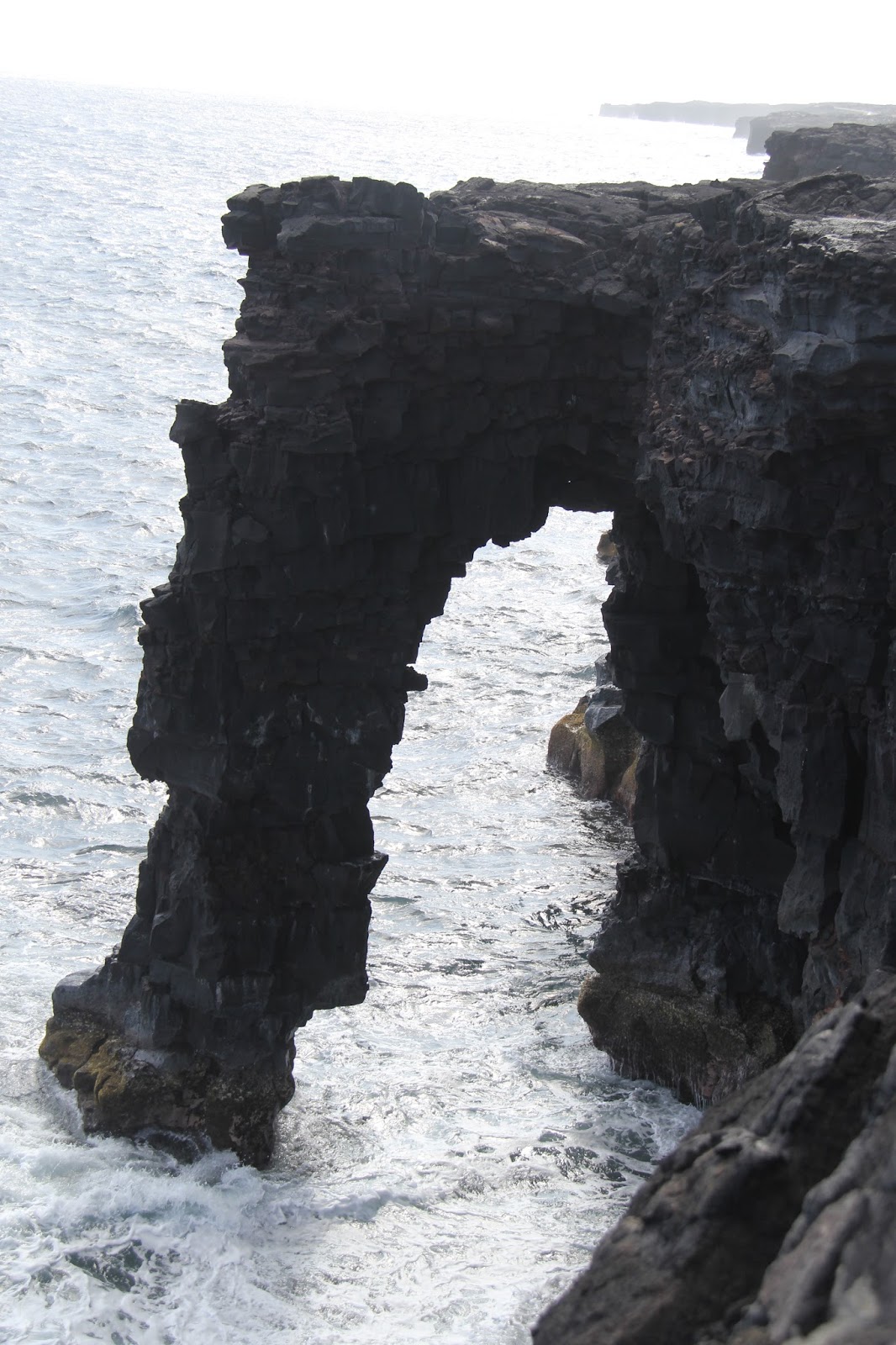
However, the awe-inspiring views at the end of this road are worth the effort if you have the time. The road continues to twist and turn over the bumpy and rutted pavement until you finally reach the Holei Sea Arch. Sea arches are formed when lava is continuously pounded by the surf until it is undercut in the shape of an arch.In a park where the main attraction is an ever-changing force of nature, there is no telling how the landscape could change. Since 1983 Kilauea has been eating portions of the Chain of Craters Road and covering the villages on it with its lava flows.
Never-the-less its lure is in its drama. In experiencing the true youth of the Big Island and the reality that it is still being born.
Currently the park allows visitors to walk 5 miles (one-way) down Chain of Craters Road to where the lava begins. This is rough terrain walking. If you plan on hiking beyond where the lava meets the road please take a few precautions. Bring plenty of water, approximately three quarts for the entire hike. Carry rain gear, sun block, and flashlights. The temperature drops with the sun, so carry a lightweight jacket or sweatshirt just in case. There is another option of viewing the active lava flowing into the ocean. See Kalapana Lava Hike
No one is entitled to see the lava on the Big Island, its ebb and flow is very dynamic, ever changing. We were lucky to be visiting at a time when in the recent past 13 year history, the lava out pour into the ocean has been a phenomenal sight to behold.
There are very few places on earth where you can see lava in person. And even fewer where you can walk right up to it. Kalapana on the Big Island of Hawaii is the safest and easiest access to see actual lava flow. The added bonus here was that there was an option to rent bikes to get to the fiery spout approximately 4-5 miles away.
Although it is a long and circuitous route to the south eastern tip of the island by car it is definitely an experience to be had and one not to the missed!
Renting bikes was a very easy process, the vendors are right around the car park area. Make sure to test ride the bike and adjust seats etc before riding into a magnificent sunset.
And what a bike ride it was! While going in, the wind is at your back...making it an easy exhilarating one. As you bike (or hike which is also an option) across the fields of lava its difficult to imagine that Kalapana used to be home to a fishing village. In 1986, lava started flowing out of the Kīlauea volcano toward the town and ended up destroying it. The lava continues to flow to this day and the town is now completely buried. So although it was a thrill ride across unimaginable landscape and a chance to marvel the unstoppable force of nature, a point to remember is that it is a historical site and reverence should be had for the residents that lost their homes.
Someone described the surreal landscape as the crust of a freshly baked brownie...burnt to some extent and magnified thousand fold.
The molten lava hardens so fast that the rock still looks like its in motion. With bumps and cracks, swivels and spirals, deep crevices , its tricky to walk on them..and headlights or flashlights are necessary if you're attempting to hike it after dark. Bear in mind, this isn't an easy hike and definitely leave your fuzzy slippers and flip flops behind. Here you experience the untamed side of the ever-changing Big Island with new land forming right beneath your feet!
At end of the 4.5 miles gravel bike path, you abandon your bike to walk by foot another half mile over the crusty uneven terrain to get to the edge of the ocean cliff. Lo and behold what words cannot describe, it is a sensation, a reawakening of sorts, a wondrous phenomenon to watch. From here you can witness a torrent of lava gushing into the Pacific almost in a perfect waterfall like pattern. It is one of the most amazing events we have witnessed.
What was spectacular was the rate at which the hot magma, seen as a strong flow of bright orange molten rock, was hitting the sea. At Kīlauea's ocean entry, the interaction of molten lava flowing into cool seawater caused pulsating littoral explosions that threw spatter (fragments of molten lava) high into the air along with clouds of bellowing dense steam. It was indeed a 'Fire-hose' of molten lava plummeting into the deep sea.
There are hot and deep earth cracks running parallel to the sea cliff around the entry point and it’s a very unstable and hazardous area! The park staff has cordoned off sections and determined the safe zone from where the viewing is spectacular. Pay heed to this! The views from here are breathtaking and you find yourself just standing in awe and appreciation of the sheer force and power of mother nature. A definite must see and must do experience on the Big Island. One that will take your breath away and leave you with a lasting impression deep within.
Tip: Carry water, headlights or flashlights. Wear sturdy shoes and heed the caution signs. The last thing you want to leave behind is a part of your melted foot!
Without a doubt, the star attraction on the Big Island is the youngest yet very much alive Kilauea volcano which has been constantly erupting from vents either on its summit (caldera) or on the rift zones since 1983! Yes...for more than 30 years, its considered to be one of the most active volcanoes in the world! Needless to say it was the first thing we wanted to see and experience first-hand.
Bless the patient park rangers at the Hawaii Volcanoes National Park who see thousands of visitors daily and field the number one 'burning' question on everyone's mind....'where can I see the lava flow from'! Because the flow of lava is so dynamic, the access to view it also follows suit. Best advise is to start at the visitor center and get the latest maps, view points and guide before you set out. It helps you plan your day(s) as well.
The Jagger Museum overlook off the crater rim drive has an uninterrupted view of Halemaʻumaʻu Crater which is a pit crater located within the much larger summit caldera of Kīlauea (see note below on the difference between a crater and a caldera) This crater is currently active containing a lava lake from where the near-permanent gas plume rises.
How does one describe watching a crater billow with smoke and glow from a lava lake that’s hundreds of feet below the surface? Somehow the words amazing and incredible just don’t do enough to adequately describe this sight.
Ideal times to see Halemaʻumaʻu's eruptive activity is around dusk and dawn where you have an opportunity to see both the red glow from the lava lake as well as the plume.
Note: Volcanic craters and calderas differ mainly in the way they are formed. Craters tend to be more nearly circular than calderas, and they are often, though not always, smaller than calderas. Craters are the vents through which gas and magma are ejected, while calderas form as a result of local collapse of the surrounding rock.
What to know when you go:
Since Halemaʻumaʻu is located within Hawaii Volcanoes National Park, you must pay a $10 fee for park entry. This fee allows you entry in to the park for 7 days. There is plenty to see and do inside the park besides Halemaʻumaʻu. If you have the time, you could easily spend 2-3 days here.
With incredible adventure at every bend and turn, our first-time Hawaiian vacation to Big Island and Oahu was by far our most physically challenging vacation yet!
The Islands offer an astonishing array of topography and an undoubtedly wild ride passing through rain, clouds, sun, shade, winds and did I mention winds!
Yet nowhere else have we been so confronted by the power and stark beauty of nature; wonder struck by the brilliance of a stellar star-studded sky; overwhelmed by the combined forces of elements; loudly reminded of how alive and powerful this earth is.
The Big Island lives and breathes like nowhere we’ve been before — perhaps because it’s still being formed beneath our very flip-flops, with lava constantly creating new landmass.
Here, the ‘Aloha’ spirit which is a well-known reference to the attitude of friendly acceptance also refers to a symbiotic relationship and an acknowledgement of that relationship with everything in the universe around you, and recognizing exactly what your space within that is.
In the Hawaiian language, aloha stands for much more than just “hello” or “goodbye” or “love.” Its deeper meaning is “the joyful (oha) sharing (alo) of life’s energy (ha) in the present (alo).” And THAT was Hawaii’s gift to us, the monumental power of ‘now’, which pretty much sums up our experience!